Table of Contents
Why Businesses Are Switching to Custom OMS in 2026
In 2026, an Order Management System, or OMS, is no longer just a backend tool for handling transactions. It has become a core operational platform that helps businesses manage what happens after an order, request, or service commitment is created. Modern OMS platforms now touch order tracking, fulfilment, payments, invoicing, customer care, and the coordination of people, systems, and partners involved in delivery. Major enterprise platforms also emphasize real-time visibility, workflow automation, and integration across business systems, which is exactly why OMS has become more important this year.
That shift is also changing what businesses expect from software. Many companies are discovering that standard, one-size-fits-all systems are not built for the complexity of today’s operations. Growth brings new channels, new approvals, new service models, and new customer expectations. In that environment, businesses are moving toward custom OMS solutions that can be tailored to their own business model, workflow, and service requirements instead of forcing teams to work around software limitations.
Why OMS matters more in 2026

Operational speed is now directly tied to customer experience and internal efficiency. Businesses are expected to process orders faster, respond to exceptions sooner, and keep teams aligned with accurate, real-time information. Stripe describes automated order management as software moving the full order lifecycle forward with minimal manual intervention, using real-time data and predefined rules. Microsoft similarly frames business process automation as a way to replace repetitive manual work with faster, more accurate workflows.
This matters because operations are no longer isolated inside one department. Sales, service, finance, fulfilment, field teams, and support often depend on the same flow of information. An OMS that connects these moving parts creates smoother execution, while a disconnected setup leads to delays, duplicate work, and poor visibility. That is why businesses in 2026 are treating OMS as a strategic system, not just an operational add-on.
The limitations of one-size-fits-all systems
Off-the-shelf tools can work at the beginning. They are quick to deploy and often cover the basics. But as a business grows, standard systems usually start showing cracks.
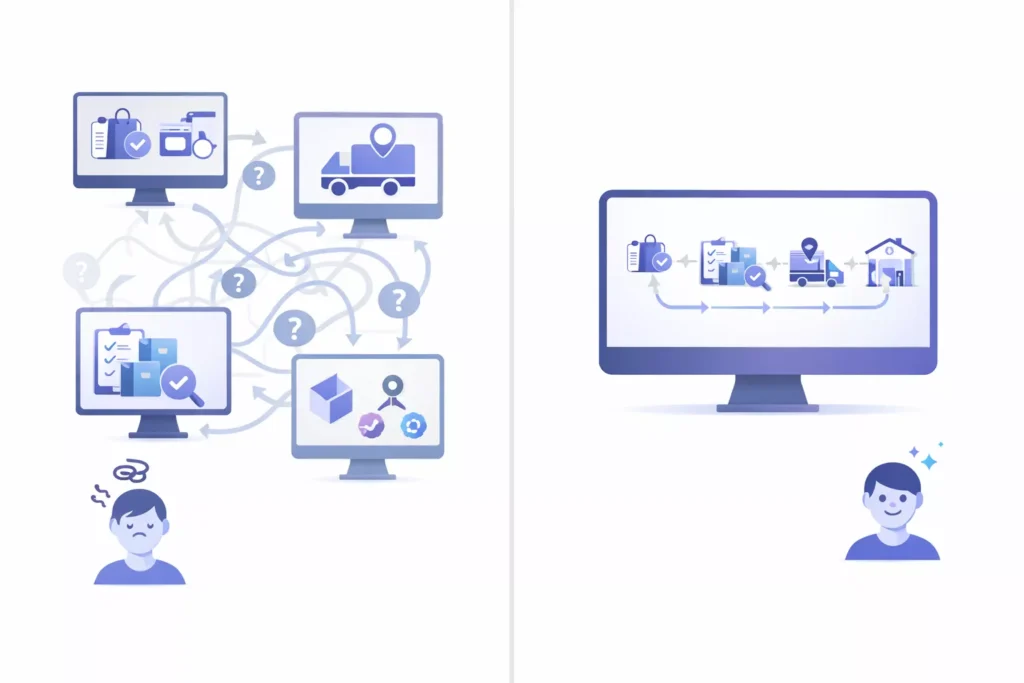
The biggest issue is rigidity. Every business has its own order flow, approval process, customer communication style, pricing logic, service timeline, and reporting needs. Oracle’s documentation on order management and field service workflows shows how much businesses rely on configurable business rules, conditions, and process logic to reflect real operations. When a platform cannot adapt to that reality, teams end up using spreadsheets, emails, manual approvals, and disconnected workarounds.
Another limitation is shallow integration. In many companies, the order journey touches CRM, ERP, finance, inventory, field service, support, and external partner systems. Generic software often handles one part of the process well but struggles to orchestrate the full flow. Oracle’s integration guidance for order management explicitly focuses on running processes across cloud and on-premise applications, while IBM positions hybrid integration as a way to bring apps, APIs, events, files, and B2B processes under one control plane. That tells you something important: modern operations depend on connected ecosystems, not standalone tools.
Why businesses are choosing custom OMS
A custom OMS is built around the way your business actually works. That means your platform supports your workflows instead of forcing your workflows to fit the software.
1. Flexibility that matches the business
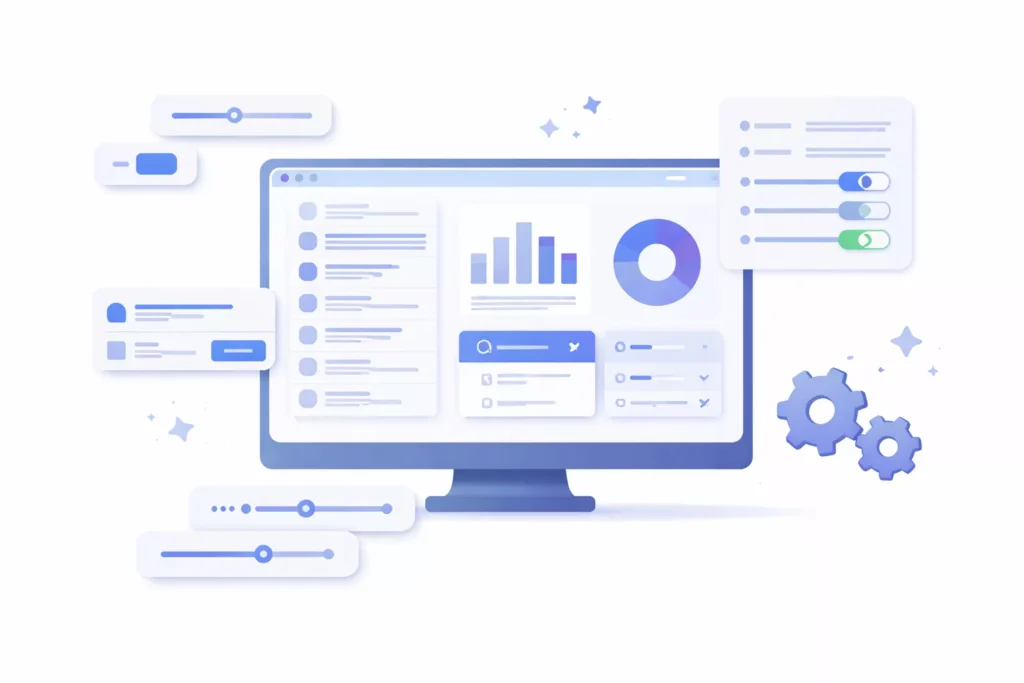
A custom OMS can reflect your order lifecycle from the beginning. It can support multi-step approvals, service-specific workflows, custom pricing logic, invoicing stages, partner handoffs, or exception rules that are unique to your business. Oracle’s order management documentation highlights the role of business rules in implementing company policies and runtime decisions, which is exactly the kind of flexibility growing businesses need.
This is one of the biggest reasons businesses are switching in 2026. They want software that fits how they sell, deliver, and support. Not how a generic vendor assumes they should operate.
2. Better visibility across operations
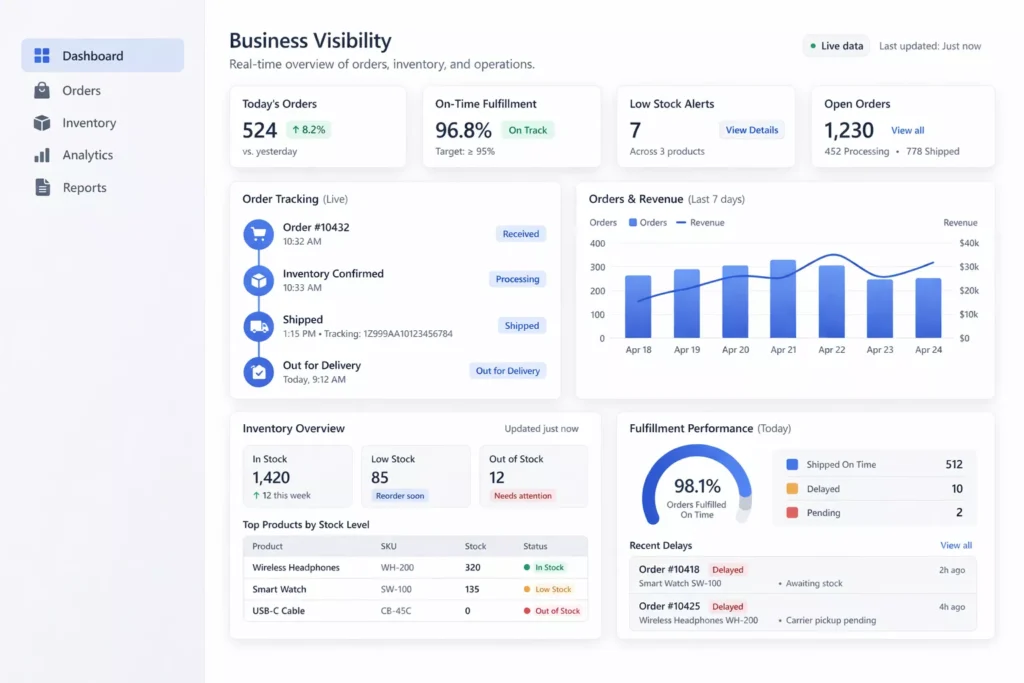
Custom OMS solutions also improve visibility. IBM’s inventory visibility tools focus on synchronized, real-time views across multiple systems and locations, while Oracle emphasizes coordination across channels and fulfilment sources. In practical terms, that means teams can see where an order stands, what is pending, what is delayed, and what needs attention next.
That level of visibility improves team coordination. Sales can set better expectations. Operations can act faster. Finance can follow invoicing and payment stages more clearly. Service teams can manage handoffs without confusion. Leadership gets a better picture of bottlenecks and performance. Instead of chasing updates across different tools, everyone works from a shared operational view.
3. More automation, less manual work
Manual operations slow growth. They also create errors. When people are copying data between systems, checking statuses by hand, or managing approvals through email, efficiency drops quickly.
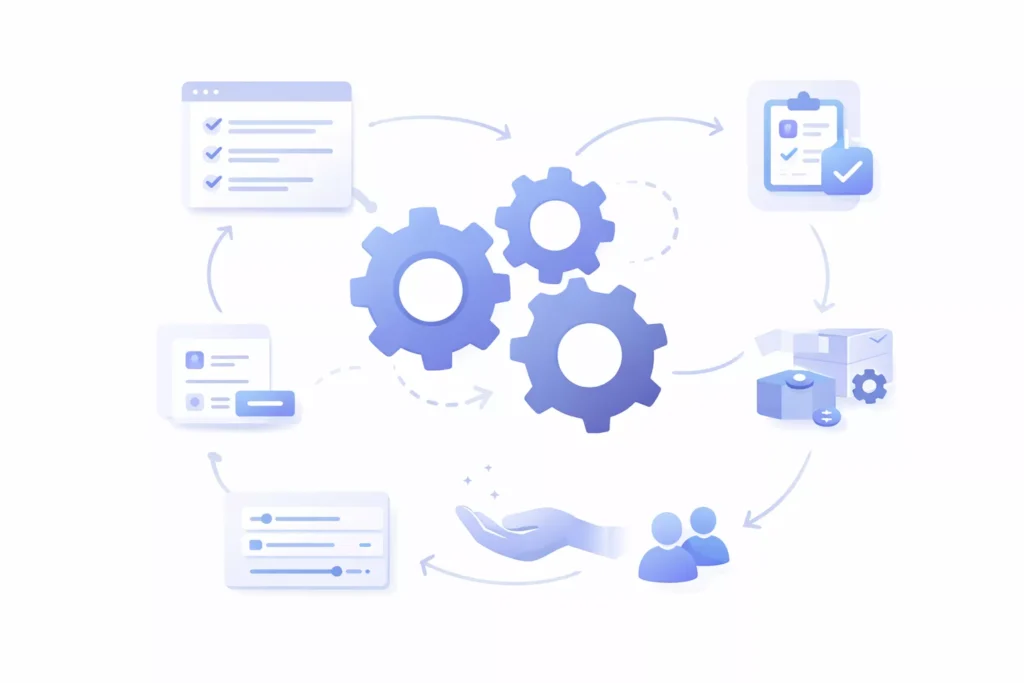
Custom OMS platforms solve this by automating the routine but keeping control where it matters. Microsoft points to automation as a way to reduce errors, lower costs, and free employees for higher-value work. Microsoft’s approval workflows and Oracle’s workflow conditions also show how businesses can automate multistage processes while still keeping human review in the loop when needed.
For businesses in 2026, this is a major advantage. A custom OMS can automatically route requests, trigger notifications, assign teams, update statuses, create invoices, or escalate exceptions. The result is a smoother operation with fewer delays and less dependence on manual follow-up.
4. Scalability for growth
What works for 100 orders, requests, or service cases often breaks at 1,000. Growth introduces more complexity, more integrations, more users, and more exceptions. IBM highlights auto-scaling visibility infrastructure, while enterprise OMS vendors increasingly position their platforms around real-time orchestration across channels and fulfilment environments. Businesses are switching because they need systems that can grow with them, not systems they will outgrow every year.
A custom OMS gives businesses room to scale in stages. You can start with core workflows, then expand into reporting, partner integrations, field operations, customer portals, or advanced automation as the business evolves. That makes the investment more practical and more sustainable over time.
Custom OMS is not just for product-based businesses
One of the biggest misconceptions about OMS is that it only applies to retail, ecommerce, or distribution. In reality, custom OMS solutions are used across different industries because they can be tailored to each client’s unique business model, workflow, and service requirements.
Yes, product-based companies use OMS for inventory, fulfilment, and delivery coordination. But service-oriented businesses can use the same concept to manage service requests, approvals, scheduling, invoicing, work orders, field execution, and customer follow-up. Salesforce’s definition of order management includes payments, invoicing, and customer care. Oracle Field Service focuses on configurable business rules and workflows for activities, and IBM’s work order platforms emphasize lifecycle management from initiation to closure. Those examples show that modern order management is really about orchestrating work, commitments, and delivery, not just shipping physical products.
That is why custom OMS is increasingly relevant for manufacturers, wholesalers, B2B service providers, maintenance teams, field service organizations, subscription businesses, and companies with complex approval-driven operations. If your business has a repeatable flow from request to delivery to payment, a tailored OMS can help structure, automate, and scale it.
Conclusion
Businesses are switching to custom OMS in 2026 because standard systems are no longer enough for modern operations. They need platforms that fit their workflow, connect their systems, improve visibility, reduce manual work, and support long-term growth. A custom OMS delivers that by aligning software with the way the business actually runs.
For companies looking to improve operations and service delivery, the real value is not just managing orders better. It is building a smoother, more connected business around them. And that is exactly why custom OMS is becoming a smarter investment across industries.
If your current system is creating bottlenecks instead of removing them, this may be the right time to explore a custom OMS built around your business, not the other way around.
Support for eMail
supportmail@deepit.com
+91 99 789 369 78
Support for Web
supportweb@deepit.com
+91 99 789 369 56