Table of Contents
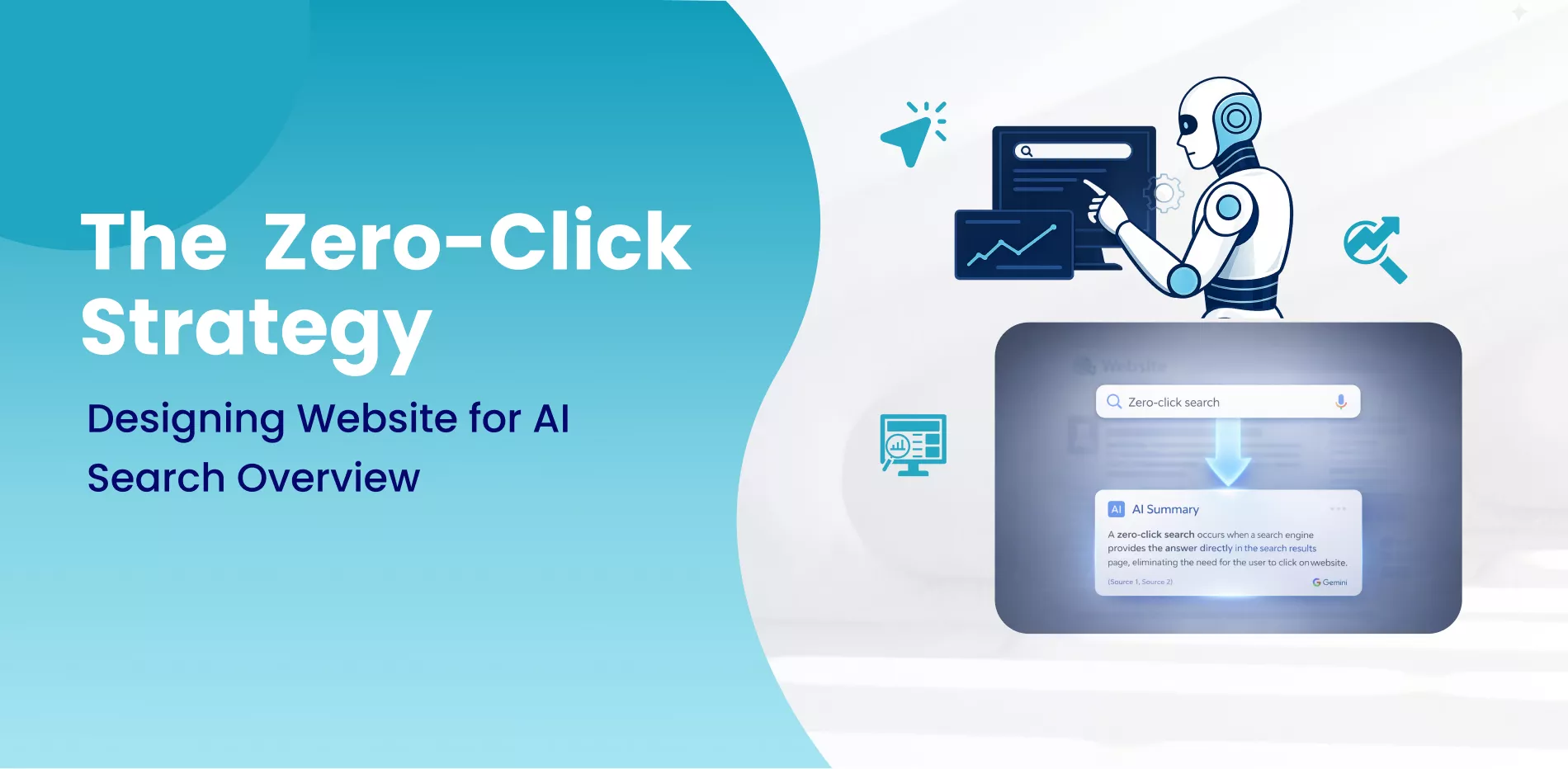
The “Zero-Click” Strategy: Designing Websites for AI Search Overviews
The rules of search engine optimization are being rewritten. For years, the goal was simple: rank high on Google and earn that coveted click to your website. But today, a growing number of searches end without a single click. Users get their answers directly in the search results, through AI-powered overviews that synthesize information from multiple sources into a coherent summary.
This shift to zero-click searches isn’t a temporary trend. With Google’s AI Overviews, Bing Copilot, ChatGPT Search, and Perplexity gaining traction, search engines are fundamentally changing how they deliver information. The question is no longer just “How do I rank?” but “How do I stay visible and valuable when users never visit my site?”
This article explores the zero-click landscape and provides a strategic framework for designing websites that thrive in an AI-first search environment. Whether you’re a business owner, marketer, or content strategist, understanding this shift is essential for maintaining your digital presence and competitive edge.
What is a Zero-Click Environment?
Zero-click searches occur when users find the information they need directly on the search engine results page (SERP) without clicking through to any website. This isn’t entirely new. Featured snippets, knowledge panels, and local business information have been answering queries directly for years. What’s changed is the scale and sophistication of these answers.
AI search overviews take zero-click to the next level. Instead of simply extracting a snippet from one webpage, AI systems like Google’s Gemini-powered overviews analyze content from multiple sources, synthesize the information, and present a comprehensive answer complete with context, nuance, and relevant follow-up questions. These AI-generated summaries appear at the top of search results, often with small citations to source websites but no guarantee of clicks.
For website owners, this creates a paradox. Your content might be featured and cited in an AI overview, demonstrating expertise and building brand awareness, yet you may see fewer visitors actually landing on your pages. Traditional SEO metrics like click-through rates (CTR) are declining for many informational queries, while impression counts climb. The relationship between visibility and traffic has fundamentally changed.
Why Zero-Click Matters for Businesses
The immediate reaction to zero-click search is often concern. If people aren’t clicking through to your website, how do you generate leads, build relationships, or demonstrate value? This is a valid worry, but it misses a crucial point: visibility without clicks still matters enormously.
When your content is cited in an AI overview, you’re accomplishing several important goals:
- Building brand authority: Being selected as a source signals to users that you’re a trusted expert in your field. Even if they don’t click today, they’ll remember your brand when they’re ready to make a decision.
- Establishing trust: Repeated appearances in AI overviews create familiarity. Users begin to associate your brand with reliable, high-quality information.
- Maintaining competitive positioning: If your competitors appear in AI overviews and you don’t, they’re gaining mindshare and authority at your expense.
- Capturing earlier-stage awareness: Users researching topics may not be ready to engage deeply, but being present during their research phase keeps you top-of-mind for later conversion opportunities.
The risk of ignoring AI overviews is significant. Businesses that fail to optimize for AI-powered search risk becoming invisible in their industry’s most important discovery moments. Your content might be excellent, but if AI systems can’t easily parse, understand, and cite it, you’re effectively absent from the conversation.
How AI Systems Choose and Synthesize Content
Understanding how AI search systems select and present content is key to optimizing for them. While the exact algorithms are proprietary and constantly evolving, certain patterns are clear.
AI search systems prioritize content that demonstrates:
- Clear structure and semantic HTML: Well-organized pages with proper heading hierarchies (H1, H2, H3) and semantic markup help AI understand content relationships and identify the most relevant sections to extract.
- Strong topical relevance and expertise: AI systems evaluate whether your content comprehensively addresses the topic and whether your site has established topical authority through multiple related, high-quality pages.
- Clean, unambiguous answers: Content that directly answers questions without unnecessary preamble or marketing fluff is more likely to be featured. AI systems favor clarity and conciseness.
- Structured data and schema markup: Schema.org markup provides explicit signals about content type, helping AI systems understand what information you’re presenting and how to categorize it properly.
- E-E-A-T signals: Expertise, Experience, Authoritativeness, and Trustworthiness remain critical. AI systems look for author credentials, first-hand experience indicators, citations to reputable sources, and signals that your content is reliable and accurate.
The synthesis process itself is sophisticated. AI doesn’t simply copy and paste from source websites. It reads multiple pages, identifies consensus and contradictions, evaluates source credibility, and generates a narrative that answers the user’s query comprehensively. Your content needs to be easily parsable to participate in this synthesis.
Principles of a "Zero-Click" Website Strategy
Designing for AI overview-friendly content requires rethinking how you structure and present information. The following principles create a foundation for zero-click success:
Information Architecture and Hierarchy
Your site’s structure should reflect clear topical clusters. Group related content together and use internal linking to establish relationships between pages. Create pillar pages that comprehensively cover broad topics, supported by cluster content that addresses specific subtopics in depth. This topical architecture helps AI systems understand your expertise and authority.
Answer-First Content Design
Lead with answers, not marketing copy. When users (or AI systems) land on your page, they should immediately encounter the information they’re seeking. Consider starting key sections with direct, concise answers before expanding into detail and context. This “inverted pyramid” approach serves both human readers who skim and AI systems that extract key points.
FAQ Sections and Q&A Formatting
FAQ sections are exceptionally valuable for zero-click optimization. They naturally align with how people ask questions and how AI systems look for answers. Structure FAQs with clear question headings (using natural language that matches search queries) followed by concise, complete answers. Each FAQ item should be self-contained, providing value even when extracted from context.
Skimmable Formatting
Make content easy to scan and extract:
- Use descriptive, benefit-focused headings that clearly indicate what each section covers
- Break content into short paragraphs (2-4 sentences maximum)
- Employ bullet points and numbered lists for steps, features, or key takeaways
- Highlight crucial concepts with bold text (but use sparingly)
- Include tables or comparison charts for data-heavy information
Balancing Brevity with Depth
The challenge is providing AI-friendly summaries while still offering comprehensive value for users who do click through. The solution is layered content: start each section with a clear, concise summary that can stand alone, then expand with details, examples, case studies, and practical implementation guidance. This approach satisfies both AI extraction needs and human reader engagement.
E-E-A-T Implementation
Strengthen expertise signals throughout your site:
- Include author bios with relevant credentials and experience
- Add publication dates and last-updated timestamps
- Cite reputable sources and link to supporting research
- Share first-hand experiences, case studies, and original insights
- Display relevant certifications, awards, or recognition
Content Design for AI Overviews
Different page types require different optimization approaches for AI search visibility.
Home page
- Clarify who you serve and what problem you solve in one sentence.
- Include a brief “What we do” section with bullet points.
- Add a mini FAQ: “Who is this for?”, “What results can I expect?”, “How do we start?”
Service pages
- Start with definition (What is the service?).
- Add benefits (business outcomes, not just features).
- Explain process (phases, timelines, responsibilities).
- Include FAQs answering real objections and natural language queries.
- Consider pricing transparency or at least a pricing ranges section to capture comparison queries.
Product pages (if applicable)
- Provide key specs, use cases, integrations, compatibility, and comparisons.
- Include How-To or Setup steps for onboarding-type queries.
- Add FAQ addressing “Will it work with…?”, “How to troubleshoot…?”, “What are the limits?”
Blog posts & resources
- Use featured snippet-style intros: a 2–3 sentence definition or answer upfront.
- Organize with H2/H3 questions (“What is…?”, “How to…?”, “Pros and cons…?”).
- Provide visuals and frameworks that reward the click (e.g., templates, calculators, downloadable PDFs).
Featured snippet style writing
- What is [topic]? One-sentence definition + 1–2 sentence elaboration.
- How to [task]: Numbered steps, concise and actionable.
- Pros and cons: Bulleted, balanced, honest.
- [Topic] vs. [Topic]: Side-by-side lists or a comparison table.
FAQ ideas targeting natural language
- “Is [solution] right for [industry/use case]?”
- “How long does [process] take and what’s included?”
- “How do you measure success for [service]?”
- “What are common mistakes with [topic] and how to avoid them?”
- “What’s the difference between [A] and [B]?”
Technical and On-Page Optimization
Technical optimization helps AI systems find, understand, and cite your content correctly.
Schema/structured data
Implement schema to clarify meaning and context:
- FAQPage, HowTo, Product, Article, Organization, LocalBusiness, BreadcrumbList.
- Ensure consistency between on-page content and schema fields.
- Keep schema up to date with real prices, availability, or authorship.
Clean URLs, meta titles & descriptions
- URLs: short, descriptive (e.g., /services/technical-seo-audit).
- Titles: incorporate the main question or intent (“Technical SEO Audit: What’s Included & Process”).
- Meta descriptions: summarize value and include a clear promise (“Learn what a technical SEO audit includes, timelines, and outcomes.”)
Internal linking & topical clusters
- Link from pillar pages to supporting articles, and vice versa.
- Use descriptive anchor text (“technical SEO audit process” instead of “click here”).
- Build contextual networks around themes (e.g., “Zero-click SEO strategy” cluster with related posts on AI overviews, schema, featured snippets, and content design).
Performance and accessibility basics
- Fast load times (Core Web Vitals).
- Mobile-first layout and typography.
- Proper heading hierarchy, alt text, and ARIA where needed.
- Secure (HTTPS), crawlable, and indexable pages.
Measuring Success in a Zero-Click World
Traditional SEO metrics need reinterpretation in a zero-click environment. Success isn’t just about click-through rates anymore.
Expand your KPIs
Beyond clicks, track:
- Impressions (how often your pages appear for relevant queries).
- Branded search lift (are more people searching your name?).
- Entity recognition (consistency of your brand, product, and author entities across the web).
- Citations in AI tools (manual checks; look for your brand/URL in AI answers).
- Engagement depth for those who do click (time on page, scroll depth, downloads).
Use Search Console & analytics differently
- In Search Console: monitor Queries and Impressions for early indicators of growing visibility in AI-synthesized topics; track position trends within topical clusters.
- In Analytics: shift reporting to assisted conversions and multi-touch attribution; measure the impact of content depth (downloads, demo requests, contact form quality) rather than only sessions.
Actionable Checklist: Are You AI Overview–Ready?
Ready to adapt your website for AI search overviews? Use this checklist to guide your strategy:
Strategy & Structure
- Have you clarified 3–6 core topics and their supporting subtopics?
- Does every key page have clear H1–H3 hierarchy and skimmable sections?
- Are your pillar pages linked to/from related blog posts and resources?
Content & Formatting
- Do you include concise answer blocks under relevant headings?
- Does each service/product page include definition, benefits, process, and FAQs?
- Do you use bullet points, numbered lists, and comparison tables where
appropriate? - Are author bios present with clear expertise and experience?
- Do you cite reputable sources and include case
studies/testimonials?
Technical & On‑Page
- Have you implemented schema (FAQ, HowTo, Product, Article, Organization,
Breadcrumb)? - Are URLs, titles, and meta descriptions clean and intent-led?
- Is internal linking descriptive and supports topical
clusters? - Is your site fast, mobile-friendly, and secure (HTTPS)?
Measurement & Iteration
- Are you tracking impressions, query coverage, and branded search in Search
Console? - Do you monitor assisted conversions and content engagement (downloads, form
quality)? - Do you have a quarterly content refresh and schema QA process?
Conclusion: Embracing the Zero-Click Future
The shift to AI-powered search overviews represents a fundamental change in how information is discovered and consumed online. While the decline in traditional click-through rates may seem concerning, this new landscape offers significant opportunities for businesses willing to adapt.
By designing AI overview-friendly content that prioritizes clarity, structure, and genuine expertise, you can maintain and even enhance your digital visibility. The goal isn’t to fight against zero-click search but to ensure your brand is present, authoritative, and memorable in these AI-synthesized answers.
Success in a zero-click world requires balancing two objectives: creating content that AI systems can easily extract and cite while still providing enough depth and value to serve users who do visit your site. This means rethinking content structure, embracing answer-first formats, implementing technical optimizations, and measuring success through new metrics that reflect visibility beyond clicks.
The businesses that will thrive in this new environment are those that see AI search overviews not as a threat but as an evolution. Your website can be both a source of excellent information for AI systems and a destination that delivers exceptional value for human visitors.
Contact us today to discuss how we can help you stay ahead of the search evolution.
- WordPress, Web design
- 5 months ago
- 924
- 11 min read
Support for eMail
supportmail@deepit.com
+91 99 789 369 78
Support for Web
supportweb@deepit.com
+91 99 789 369 56